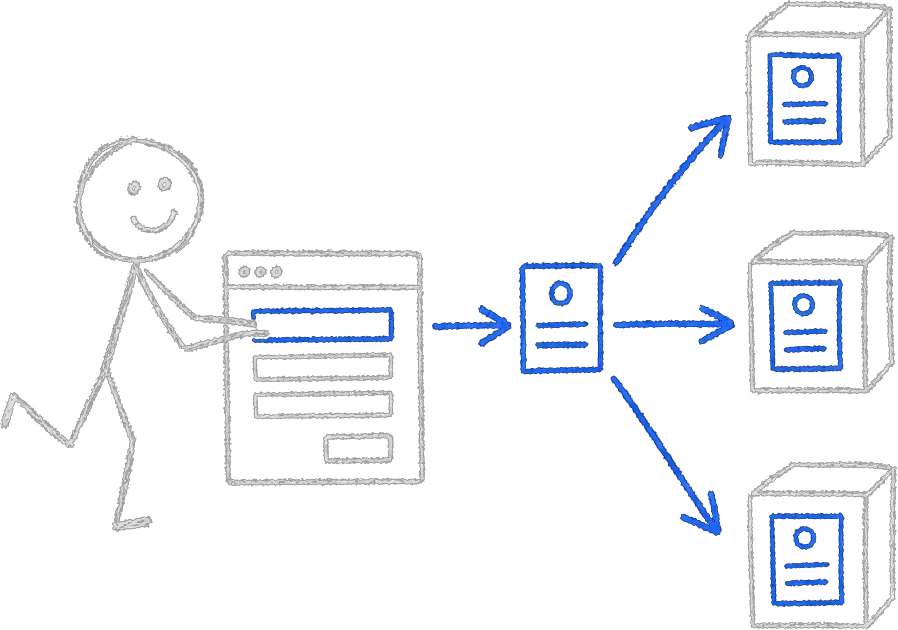
Data entry automation is the fix for records that a business retypes into three different systems. Someone enters customer information into the CRM. Someone copies it to the project tool. Someone enters it again in the billing system. The same record exists in three places and stays accurate only if all three people get it right.
Data entry automation writes data once and flows it to every system that needs it, eliminating the copying, the errors, and the hours.
Data entry automation connects your systems so information flows between them without manual intervention. A new customer record in your CRM creates a matching record in your billing system and your project management tool. A completed job in the field app updates the schedule board, the invoice queue, and the customer record all at once.
The builds are often simple. Many businesses have three to five high-frequency data flows that a person performs every day. Identifying those flows and automating them returns hours per week without any change to the tools the team uses.
Which Data Entry Flows Do We Automate?
These are the most common manual data flows we see and eliminate in small and mid-size businesses.
New customer records across systems+
A new customer entered in one system creates the matching record in every other system that needs it: CRM, billing, project tool, communication platform. No one copies the record manually.
Form submissions to CRM or database+
Web forms, intake forms, and survey responses flow directly to the right records in your CRM or database. No one checks a form submission inbox and manually enters the responses.
Order and job details to project management+
When an order is placed or a job is booked, the details flow to the project or job management board automatically. The team sees the work without waiting for a coordinator to enter it.
Spreadsheet data to operational systems+
Many businesses run hybrid workflows where a spreadsheet holds data that should be in a system. We build the sync or migrate the workflow to eliminate the spreadsheet-as-database pattern.
Email attachments and form data extraction+
Information that arrives in email bodies or PDF attachments gets extracted and entered into the right records automatically. The inbox stops being a data entry queue. See the service →
Field data to back-office systems+
Readings, inspections, measurements, and service completions captured in the field sync to back-office systems in real time rather than being re-entered at the end of the day.
E-commerce orders to fulfillment and inventory+
New orders flow to the fulfillment queue and decrement inventory automatically. Fulfillment status syncs back to the order record and to the customer-facing tracking.
Payroll and time data to accounting+
Approved time entries and payroll runs post to the correct accounts in your accounting system without a manual journal entry or export-import cycle. See the service →
Common Questions
How much does data entry automation cost?
Data entry automation is one of the most cost-effective automation investments. Simple single-flow builds start under $1,000. A typical engagement covering three to five data flows runs $1,500 to $3,500. The return on investment is usually visible in the first week of operation.
What if our systems do not have APIs?
Many older systems or desktop applications do not expose APIs. We evaluate alternative integration methods: database-level connections, file-based sync, email parsing, or UI automation. We tell you what is possible and what carries risk before any build starts.
Can automation handle data that needs validation or transformation?
Yes. Validation rules and transformation logic are part of the build. A phone number can be normalized to a standard format. A date field can be converted between formats. Records that fail validation can route to a review queue rather than entering the system with errors.
What is the difference between data entry automation and AI document processing?
Data entry automation moves structured data between connected systems. AI document processing extracts structured data from unstructured documents like PDFs and images before it can flow between systems. They often work in sequence: document processing extracts the data, then entry automation routes it.
Will data entry automation work with our legacy software?
It depends on the software. We evaluate the integration options during discovery and give you a clear picture of what is possible before any commitment. Legacy systems that expose no API and have no database access are the hardest cases, but they are not always impossible.
Outcome
01Data entered once and accurate everywhere, with no manual copying.
02Re-keying errors eliminated at the source.
03Hours per week returned from repetitive data entry to higher-value work.
04System records that stay current without a coordinator maintaining them.